
Biosimilar Entry and the Pricing of Biologic Drugs
Feng, Josh, Thomas Hwang, Jacob Klimek, and Luca Maini. “Biosimilar Entry and the Pricing of Biologic Drugs.” accepted, Review of Industrial Organization.
We show that originator biologics respond to biosimilar entry by reducing net-of-rebate prices to maintain volume, in contrast to the well-documented response of small-molecule drugs to generic entry, and provide suggestive evidence that perceived differences drive the strategic response.

Biosimilars vs. Generics
An important feature of prescription drug markets is the entry of generic versions of branded drugs. The Hatch-Waxman Act of 1984 helped facilitate the entry of generics, Generic penetration typically reaches 90% or more for most drugs after the branded version loses exclusivity.
Recently, complicated drugs known as biologics, grown from organic tissue, have become more prominent in approvals and as a share of overall drug spending. Due to their complexity, biologics cannot be exactly replicated, and are therefore immune from generic competition. The US passed the Biologics Price and Competition Act (BPCIA) in 2009, in order to facilitate the entry of biosimilars, (inexact) copies of biologic drugs. Because biosimilars are not identical copies, many have wondered if biosimilars can be effective competitors, and how reference biologics will react to biosimilar entry.

List and net price trends of reference biologics around biosimilar entry
What happens after biosimilars enter?
We combine data on list prices (measured by Wholesale Acquisition Cost, or WAC), net prices (measured using average net revenue per unit and Average Sales Price, or ASP), units sold, and formulary coverage of biologic drugs and examine how these quantities react to biosimilar entry. We find that originator biologics react to biosimilar entry by keeping list price constant but offering larger rebates.
Perhaps because of the larger rebates, we also find that biologics only suffer a slight decrease in units sold and formulary coverage after biosimilar entry.
A model of pricing strategy
We rationalize our empirical findings by building on the canonical model of generic entry by Frank and Salkever (1992). The original model explains why prices of brand drugs would increase after generic entry by arguing that brand drugs exposed to generic entry focus on a price-inelastic “loyal” segment of the market. Generic entrants instead compete for the (much larger) price-elastic segment.

Optimal pricing rule of the biologic incumbent as a function of the difference in vertical quality with the biosimilar entrant.
We solve a version of the Frank and Salkever model where the price-elastic segment is represented by a standard Hotelling model. The biosimilar entrant differs from the incumbent biologic both in terms of “travel” distance and in vertical quality. When the biosimilar is perceived as having lower quality, the incumbent has a strong competitive advantage and can capture a large portion of the price-elastic market without lowering its price too much. However, as quality differences shrink (moving from right to left on the graph), competing becomes more costly, and eventually the biologic will choose to "acquiesce" and focus on the "loyal" segment only.
Testing the implications of the model
The model predicts that “higher" quality” biosimilar entrants should capture a larger market share a trigger a weaker price response. We test this prediction by exploiting the fact that some biosimilars were approved using standard, non-abbreviated approval routes. Because these approval routes require more robust clinical evidence, biosimilars that were approved that way may be perceived as having higher quality.
We find that reference biologics that compete with these “higher-quality” biosimilars did not increase rebates in response to entry. We also find much larger drops in volume and formulary coverage for these drugs.
Key takeaways
Entry of biosimilars does appear to generate some savings. These savings cannot be detected using only invoice sales data, which may help explain why some previous studies (see, e.g., here) have argued that biosimilars are ineffective.
The way competition between biosimilars and reference biologics unfolds is a crucial determinant of the success of biosimilars (in terms of their ability to reduce prices and displace incumbents).
Recent bipartisan proposals in Congress have aimed to either reduce cost-sharing for biosimilars or provide greater incentives for physicians to adopt biosimilars. Our model suggests that these approaches could shift the equilibrium regime from a "fight" to an "acquiesce" state.
This shift could also happen more organically as more patients and physicians become comfortable with biosimilars (a 2020 poll by HarrisX found that only 35% of patients are familiar with the term "biosimilar").

Mergers that Matter: The Impact of M&A Activity in Prescription Drug Markets
Feng, Josh, Thomas Hwang, Yunjuan Liu, and Luca Maini. “Mergers that Matter: The Impact of M&A Activity in Prescription Drug Markets.” accepted, Journal of Political Economy Microeconomics.
We build a novel dataset tracking acquisitions of branded drugs. Horizontal acquisitions that escape regulatory scrutiny are followed by large price increases. Cross-market acquisitions that do not involve directly competing drugs do not have a detectable effect on prices.
Media coverage: Chicago Booth Review
Associated documents: public comment on proposed changes to the premerger notification program
M&A activity in the Pharmaceutical Market
Consolidation in the pharmaceutical industry has come under increasing scrutiny, with some policymakers raising concerns over the possible role of M&A in the significant growth of drug prices.
The Federal Trade Commission (FTC) is particularly concerned that “cross-market” acquisitions (which do not involve competing drugs) may lead to higher prices, which could happen if manufacturers are able to bundle drugs treating different diseases when bargaining with payers. However, despite the importance of this topic, empirical evidence on the effect of pharmaceutical M&A is relatively scarce.

Figure 1. Overview of M&A activity in the US pharmaceutical market
We construct a novel dataset tracking the holder of US marketing rights for the vast majority of branded drugs between 2007 and 2019 and document several patterns:
Acquisitions are extremely common: the marketing rights of over one-third of branded drugs are traded at least once during our sample period
Only one-fourth of acquisitions involve drugs in the same therapeutic area. The rest are cross-market acquisitions.
Very often, the company selling marketing rights to a drug retains the underlying IP. These licensing deals are not usually included in traditional M&A databases but represent around 30% of pharmaceutical deals.
Empirical methodology
We use data on net prices (from SSR Health) and insurance coverage (from MMIT Analytics) to study how acquisitions affect access to prescription drugs. We analyze each acquisition separately and estimate its impact on prices through a series of event studies. As comparison groups, we select drugs in the same broad anatomical category (e.g., cardiovascular) that were not acquired and have similar age and revenue as the acquired drug. We then plot the distribution of the coefficients we obtain and compare them to a placebo distribution derived by running the same event study analysis on drugs that were not acquired.
The effect of horizontal acquisitions

Figure 2. Effect of horizontal acquisitions on estimated net prices
Horizontal acquisitions (i.e., acquisitions that consolidate ownership of drugs in the same therapeutic area) lead to higher prices on average, but these price effects are concentrated among a small group of low-value acquisitions that escape regulatory scrutiny.
These acquisitions are small enough to be exempt from disclosure to the FTC, so they are not subject to regulatory scrutiny. Conversely, acquisitions above a certain size must be disclosed in advance and risk being blocked if the FTC believes they are harmful to consumers.
Low-value, “stealth” acquisitions are followed by an average 120% price increase
Disclosed acquisitions are followed by a much smaller (and noisier) increase in price
The effect of cross-market acquisitions

Figure 3. Effect of cross-market acquisitions on estimated net price
Recent bargaining theories suggest that, under some conditions, firms with large portfolios may be able to extract higher prices from payers by selling their products as a bundle. To test whether this happens in the pharmaceutical market, we look at what happens when a drug is acquired by a larger company.
Cross-market acquisitions by larger companies are followed by a small and noisy increase in price, with noticeable pre-trends.
Using formulary data, we show that even though exclusions are relatively common (between 15% and 20% on the average commercial formulary), company portfolios are almost never fully excluded. This suggests that drug manufacturer do not systematically negotiate over their entire portfolio of drugs but instead conduct class-by-class negotiations
Takeaways
Regulatory scrutiny matters: deals that are disclosed to the FTC have a smaller impact on price
Cross-market acquisitions do not appear to have an inflationary effect on price on average. However, noise in our estimates means that we cannot rule out a small effect, possibly concentrated among a subset of the deals we consider.
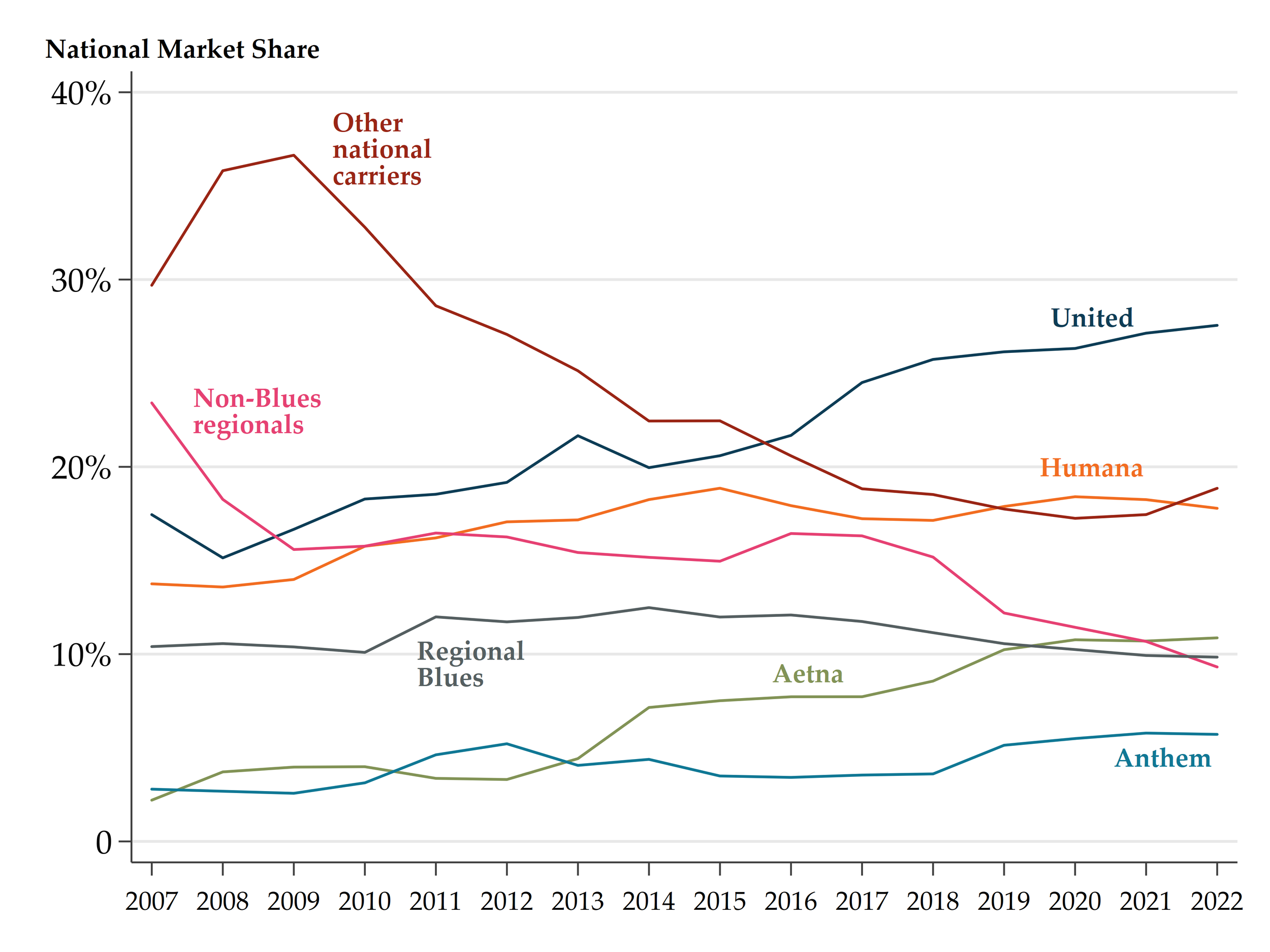
Substitutes for Success? Public versus Private Competition in Medicare Advantage
Layton, Tim, Luca Maini, and J. Michael McWilliams. “Substitutes for Success? Public versus Private Competition in Medicare Advantage.” Journal of Economic Perspectives 40, no. 2 (2026): 143-170
Competition between traditional Medicare (TM) and private insurers within Medicare Advantage (MA) acts as a substitute in incentivizing plans to deliver value. While historically, the choice between TM and MA provided a vital competitive dynamic, TM's strength as a competitor has declined significantly, shifting the burden of ensuring value for enrollees to competition within MA.
We assess the evolving role of competition in Medicare Advantage and its implications for beneficiary welfare. We describe how competition from the public option, traditional Medicare, and other private insurers within Medicare Advantage act as substitutes in incentivizing plans to deliver value. We show that while historically the choice between traditional Medicare and Medicare Advantage provided a vital competitive dynamic, traditional Medicare's strength as a competitor has declined significantly, driven by generous payments favoring private plans. Consequently, the burden of ensuring value for enrollees has shifted to competition within the Medicare Advantage market. While county-level competition among private insurers has increased, this growth is primarily driven by the expansion of large national carriers rather than new entrants. Insurers still wield substantial market power due to significant barriers to entry, raising concerns about the ability of the program to incentivize private insurers to use public dollars to maximize value for beneficiaries.

Demand Inertia and the Hidden Impact of Pharmacy Benefit Managers
Feng, Josh, and Luca Maini. “Demand Inertia and the Hidden Impact of Pharmacy Benefit Managers” Management Science 70, no. 12 (2024): 8940-8961.
Slides
We estimate a dynamic structural model of drug pricing using net-of-rebate prices of anti-cholesterol drugs from 1996-2013 and use it to argue that inertia in drug demand obscures the impact of PBMs on prices and spending.
Coming soon. In the meantime, see summary on Josh’s page.

Profiting from Most-Favored Customer Procurement Rules: Evidence from Medicaid
Feng, Josh, Thomas Hwang, and Luca Maini. “Profiting from Most-Favored Customer Procurement Rules: Evidence from Medicaid” American Economic Journal: Economic Policy 2023, 15(2): 166–197)
Online Appendix, Slides
We find that an increase to Medicaid’s minimum drug rebate under the Affordable Care Act in 2010 lowered non-Medicaid drug spending by 2.5 percent. The result is likely driven by the interaction of this reform with Medicaid’s “most-favored customer” clause (MFCC).
How do most-favored customer clauses work?
Most-favored customer clauses (MFCC), or "best price" rules, are contract provisions that guarantee a buyer the lowest price offered to any other customer by the seller. MFCCs are common in government procurement. The Medicaid Drug Rebate Program uses an MFCC to ensure that Medicaid receives the biggest discount offered to any commercial payer. MFCCs can help lower government spending, but they also incentivize firms to keep prices higher in commercial markets to avoid triggering the clause.

Overview of Medicaid drug pricing rules
For each prescription given to Medicaid enrollees, the Centers for Medicare and Medicaid Services (CMS) pay drug manufacturers the Average Manufacturer Price (AMP), which is a measure of list price that does not consider rebates or discounts offered to private payers. Manufacturers then send CMS a quarterly rebate equal to the highest rebate given to any commercial payer but not lower than a minimum rebate percentage (15.1% until 2009 and 23.1% starting in 2010). As a result, the actual price paid by Medicaid for each unit is calculated as AMP times (1 - rebate).

How does the Medicaid MFCC affect firm revenue?
Drug manufacturers negotiate rebates off of list price with large payers called pharmacy benefit managers (PBMs). Even though brand drugs are patent-protected, PBMs can leverage their market power in these negotiations to extract higher discounts and keep net prices below monopoly levels.
The Medicaid MFCC makes it harder to obtain higher discounts because each marginal increase in the discount rate lowers not only the effective price of the payer who is negotiating the discount but also the Medicaid price.
Because the Medicaid MFCC only kicks in above a certain threshold, it creates a kink in the revenue function of the manufacturer. Firms can use the kink as a “commitment” to keep prices higher.
Increasing the minimum rebate threshold makes it easier for payers to extract higher discounts because it makes it harder to trigger the Medicaid MFCC.

Diff-in-diff estimates of the change in non-Medicaid discount rates for drugs with high Medicaid Market Share after the ACA rule change.

Diff-in-diff estimates of the change in non-Medicaid revenue for drugs with high Medicaid Market Share after the ACA rule change.
Evaluating the ACA reform
In 2010, the ACA raised the minimum rebate threshold from 15.1% to 23.1%.
Economic theory predicts that the reform had a bigger effect on drugs that receive a higher share of their revenue from Medicaid.
Using a difference-in-difference framework based on differential exposure to the Medicaid market, we look for changes in average discounts and total revenue in non-Medicaid segments of the market. We find that discounts for drugs with a high Medicaid Market Share (MMS) increased after the reform.
Our results imply that the ACA reform lowered prescription drug spending in the commercial market by approximately 2.5%
Using a model-driven calibration, we estimate that removing the MFCC altogether would further reduce spending by 3.5%, though it would also likely increase Medicaid spending.
Key takeaways
We provide quasi-experimental evidence of the impact of Medicaid rules on the commercial drug market
Without data on net prices and revenue it would have been impossible to uncover the effect of the Medicaid MFCC on commercial market outcomes. This is important because most research on the pharmaceutical market uses invoice prices and sales numbers.
The ACA rule change appears to have lowered drug spending for both Medicaid and commercial payers, although our analysis is limited to drugs already on the market. Drugs launching in the future have more flexibility in setting list prices and may be able to counteract the effects of the policy more effectively.

Reference Pricing as a Deterrent to Entry: Evidence From the European Pharmaceutical Market
Maini, Luca, and Fabio Pammolli. “Reference Pricing as a Deterrent to Entry: Evidence from the European Pharmaceutical Market” American Economic Journal: Microeconomics, 2023, 15(2): 345–383
Online Appendix, Slides
We estimate a structural model to show that drug manufacturers delay the launch of novel drugs in low-income European countries by up to one year in response to incentives generated by External Reference Pricing policies
Media coverage: StatNews, RealClearPolicy, The Economist
What is reference pricing?
Reference pricing is the practice of using the price of a drug in foreign countries as a benchmark for price negotiations. It is a convenient policy for governments who want to ensure their prices are “reasonable” and do not want (or lack the funds) to invest in expensive health technology assessments. Many governments use reference pricing, and both the Trump and Biden administrations have discussed adopting it for Medicare Part B drugs at some point.

How can reference pricing affect access to new drugs?
Reference pricing limits the ability to price discriminate across countries with different income levels. In Europe, reference pricing is widely used even between countries with very different price levels (for example, Italy references many small Eastern European countries such as Estonia, Latvia, and Lithuania). When manufacturers decide their optimal launch strategy, they have to worry about the potential negative spillover that launching in a low-income country (at a low price) will have on their profits in the rest of Europe. Sometimes, they may decide that delaying entry is better for profits.

Fraction of new drugs available in select European countries 6 years after approval. Source: IMS Health and EMA
Descriptive evidence of the impact of reference pricing
Even though new prescription drugs can receive marketing approval for all EU countries simultaneously, many drugs aren’t available in Eastern Europe for multiple years.
Even after controlling for revenue, access is inversely correlated with price, suggesting low prices cause delays.
Alternative explanations like fixed entry costs, bureaucratic requirements, or capacity constraints can only explain short-term delays in Western Europe, not long-term ones in Eastern Europe.
Isolating the impact of reference pricing
Because delays have many potential explanations, it is hard to disentangle the impact of reference pricing from other possible sources.
We exploit the way reference pricing affects profits. Firms delay entry on purpose if the revenue from launching in an additional country is lower than the projected loss from lower prices elsewhere.
Using a model of optimal entry decisions, we back out a model-driven estimate of when delaying makes sense from the point of view of profit maximization.
We use moment inequalities to derive restrictions on the underlying model parameters.

Marginal impact of reference pricing on delays by country
Results
Reference pricing is responsible for over half of all delays in Eastern European countries (up to one year).
We rule out reference pricing as the cause of delays in Western Europe.
Differences in market size drive this result: new drugs earn less than 5% of their EU lifetime revenue in Eastern Europe. Therefore, even a small effect driven by reference pricing is enough to justify delays.
Our estimates suggest that the EU could eliminate reference-pricing-caused delays by compensating manufacturers with lump-sum payments on the order of €18 million.
Key takeaways
Firms can react to pricing regulation along margins other than price (in this case, entry strategy)
Implementing reference pricing in the US will likely lead to longer access delays (and higher prices) in referenced countries, limiting the effectiveness of such policies.
Assessments of US reference pricing that do not take into account firm strategic responses (see, e.g., here) will overestimate potential price reductions and savings
Increased price transparency across countries could exacerbate the impact of reference pricing by making it easier for referencing countries to access information on foreign prices and ultimately reduce access to new drugs.